
Literacy Support for Early Readers in Dumfries, VA
Speech-language-informed reading and spelling support for preschool and elementary children.
Early reading is more than memorizing letters or practicing worksheets. Children need to hear sounds in words, connect sounds to letters, blend sounds together, spell words, understand language, and build confidence with real reading.
When reading feels hard early on, support should not wait until a child is deeply frustrated or falling further behind. Early, targeted literacy support can help children build the foundational skills they need before reading and spelling become a daily source of stress.
At Play to Say Therapy, literacy support is structured, practical, and individualized. Jenn combines her background as a speech-language pathologist, educator, M.Ed., AMI Montessori diploma holder for Primary-age children, and classroom practitioner to help early readers build the language and literacy skills they need for school and everyday life.
Is early reading harder than expected?
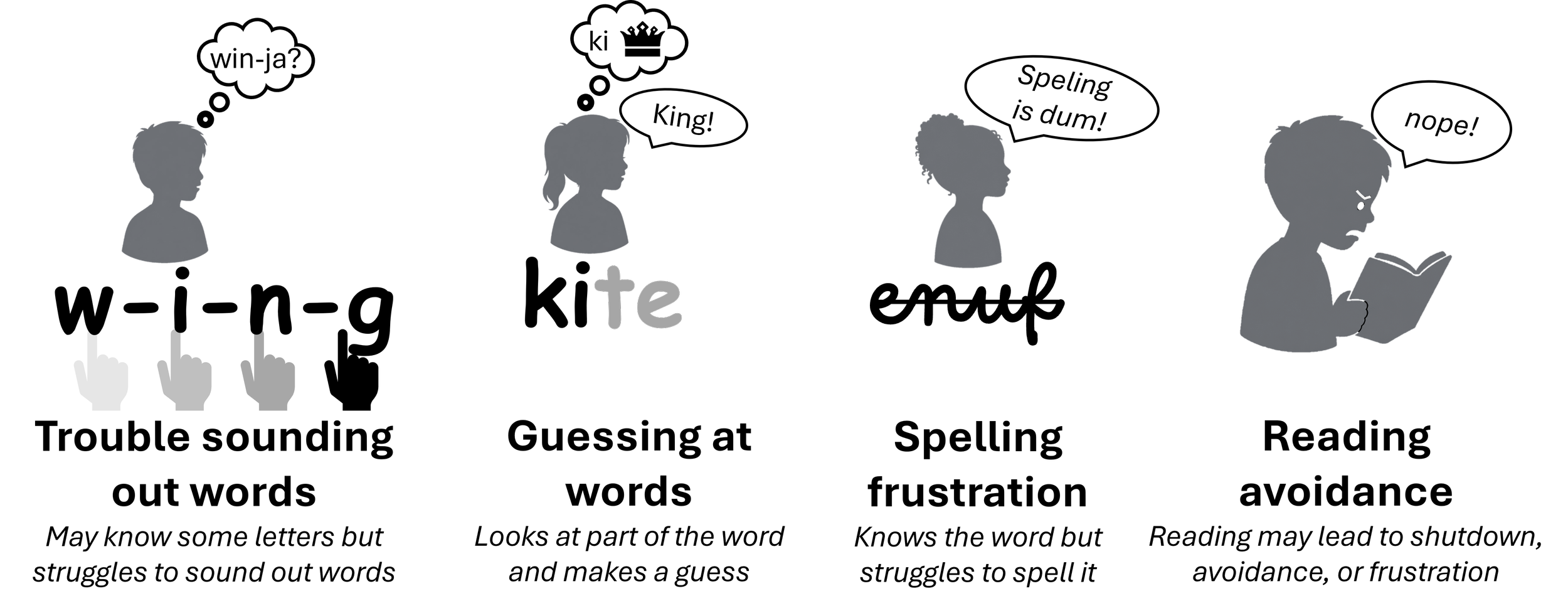
Some children are bright, curious, and verbal, but reading and spelling still feel frustrating.
English reading often requires explicit instruction. English is a complex written language that evolved over time rather than being neatly designed. As a result, spelling patterns, sound-letter relationships, and “rules” are not always intuitive for young children.
You may notice your child:
Has trouble rhyming or hearing distinct sounds in words
Knows some letter names but cannot use them to read words
Guesses at words based on the first letter or picture
Has difficulty sounding out simple words
Struggles to blend sounds together
Has trouble spelling words that seem “easy”
Avoids reading or becomes upset during reading practice
Has difficulty remembering sight words or irregular words
Needs much more help with reading homework than expected
Has a teacher, preschool, or homeschool parent raising concerns about reading readiness
These signs do not mean your child is lazy or not trying. They may mean your child needs more explicit, structured support with the language foundations of reading.
Why early support matters
Early help can change the reading path.
Reading struggles can build on themselves. When reading feels hard, children may avoid books, read less often, and get fewer chances to practice. Over time, this can affect vocabulary, spelling, comprehension, confidence, and school participation.
This pattern is sometimes called the Matthew Effect in reading: children who find reading easier often read more and keep gaining skills, while children who struggle may fall further behind without targeted support.
The goal of early literacy intervention is not to pressure children or rush development. The goal is to identify what is missing, teach it clearly, and help reading feel more understandable and successful.
At Play to Say Therapy, early literacy support helps children build skills step by step so they can experience success before frustration becomes the pattern.
Reading begins with language.
Before children become confident readers, they build skills through listening, speaking, sound play, songs, rhymes, stories, vocabulary, conversation, and shared books.
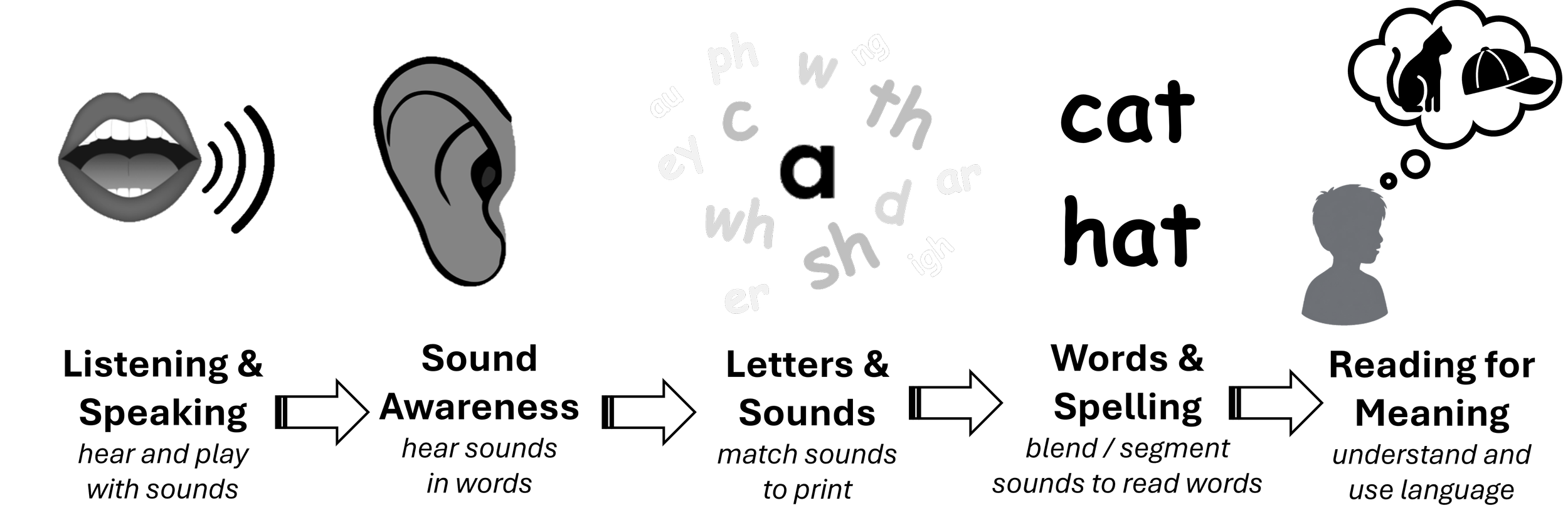
Early readers need to understand that words are made of sounds. They also need to connect those sounds to letters, blend sounds into words, spell words, and make meaning from what they read.
Speech and literacy support should also respect each child’s language background, culture, and dialect. Children may pronounce words differently based on regional, cultural, or community speech patterns. Those differences are not automatically “errors.” Skilled literacy support helps children understand how spoken words connect to written English while respecting the way they and their families speak.
That is why literacy support at Play to Say Therapy looks at more than printed words on a page. We consider how your child hears sounds, says sounds, understands words, follows language patterns, tells stories, and uses language to make meaning.
Jenn’s clinical and educational background allows her to support literacy through multiple lenses:
Speech and sound development
Phonological awareness
Language comprehension
Vocabulary and oral language
Early childhood development
Montessori-informed, hands-on learning
Classroom readiness and participation
For many early readers, the goal is not just to “practice more.” The goal is to identify what is missing and teach it clearly.
Why work with an SLP for literacy?
An SLP brings a language lens to reading.
Speech-language pathologists are trained to evaluate and support the speech and language skills that help children learn to read and write. This can be especially helpful when a child has a history of speech sound errors, language delay, difficulty following directions, trouble retelling stories, unclear speech, AAC needs, neurodivergence, or broader developmental concerns.
Jenn also brings an educator’s lens. She holds an M.Ed. and an AMI Montessori diploma for Primary-age children, along with years of direct classroom experience. This means literacy support is not only clinically informed; it is also developmentally appropriate, engaging, and grounded in how young children learn.
At Play to Say Therapy, literacy support may address:
Hearing and manipulating sounds in words
Connecting letters with sounds
Blending sounds to read words
Breaking words apart for spelling
Building confidence with decodable text
Strengthening vocabulary and comprehension
Supporting attention, participation, and regulation during learning
Helping parents understand what to practice at home
This is structured literacy support with a whole-child perspective.
How Play to Say Therapy helps early readers
Structured support. Clear next steps. Practical home carryover.
Literacy sessions are individualized based on your child’s current skills and needs. Depending on the child, support may include:

Phonological and phonemic awareness – Helping your child hear and work with sounds in words, such as rhyming, identifying beginning sounds, blending sounds, and segmenting words into individual sounds.
Letter-sound connections – Helping your child connect printed letters and letter patterns with the sounds they represent.
Decoding – Teaching your child how to sound out and read words more accurately and confidently.
Encoding and spelling – Helping your child use sound-letter knowledge to spell words systematically, not just memorize them.
Word chains – Using structured word chains to help children see, hear, read, and spell how words change one sound or letter at a time. For example, a child may work through a chain such as:
sat → sit → sip → tip → tap
This helps children connect decoding and encoding so reading and spelling become more automatic.
Irregular words – Teaching words that a child cannot easily sound out using the spelling patterns they already know.
This can happen for two reasons:
The word has an unusual spelling pattern.
Some words do not follow the most common sound-spelling rules, or they have a spelling pattern that only shows up in a few words. These are words children may need to learn by repeated practice.The word includes a spelling pattern the child has not learned yet.
Sometimes a word seems “tricky” only because the child has not been taught that sound-spelling pattern yet. Once they learn it, the word may become easier to read.
Here are four examples of how UFLI introduces irregular words. The heart marks the part of the word that is “tricky” or does not follow the expected sound-spelling pattern. The square marks the parts of the word that can be sounded out once the pattern has been taught.

Automaticity and fluency – Using repeated, systematic practice to help children read and spell words with less effort. As skills become more automatic, children can read more fluently and focus more attention on understanding what they read.
Connected text – Helping your child apply new skills while reading phrases, sentences, and decodable passages.
Vocabulary and comprehension – Supporting the language skills that help children understand and talk about what they read.
Parent coaching and home practice – Providing short, realistic practice activities so skills can carry over outside the therapy room.
Our approach
Explicit, structured, and child-centered.
Play to Say Therapy uses structured literacy principles informed by programs such as UFLI Foundations. Sessions may include phonemic awareness, letter-sound work, blending, word reading, spelling, irregular words, and connected text.
This structure is paired with Jenn’s speech-language expertise, Montessori training, classroom experience, and play-based engagement strategies.
That means sessions are:
Structured to build real skills – Children receive clear, explicit instruction rather than guessing, memorizing, or relying only on exposure.
Flexible for young learners – Activities are adjusted for attention, regulation, confidence, and developmental readiness.
Practical for families – Parents receive clear explanations and manageable home practice, not overwhelming worksheets.
Individualized to fit the child – Support is based on the child’s current strengths, needs, learning style, and communication profile.
Individual support and literacy groups
Individual literacy support and small-group options may both be available.
Some children need individual support to build foundational skills at their own pace. Other children may benefit from a structured small-group or literacy-intensive option when children can be matched by age, skill level, and learning needs.
Small groups can give children opportunities to practice literacy skills with peers while still receiving structured instruction and support.
Group or intensive literacy support may focus on:
Phonological awareness
Letter-sound knowledge
Decoding
Spelling
Fluency
Early reading confidence
Short home practice between sessions
Placement is based on screening, parent concerns, and current literacy skills. The goal is to make sure each child is in the right setting for meaningful progress.
What to expect
Getting started is simple.

Free 15-minute discovery call – Jenn learns about your concerns, answers questions, and helps determine whether literacy support may be a good fit.
Screening or evaluation – Your child’s speech, language, and literacy-related skills may be reviewed to identify strengths, needs, and next steps.
Individualized recommendation – Jenn helps determine whether your child may benefit from individual therapy, small-group support, a literacy intensive, home practice, school collaboration, or referral to another provider when needed.
Structured sessions – Therapy targets specific skills such as sound awareness, decoding, spelling, vocabulary, comprehension, and reading confidence.
Home carryover – Families receive clear, realistic practice ideas to support progress between sessions.
Progress updates – You will know what your child is working on, why it matters, and how to support it at home.
Who literacy support may be right for
A good fit for early readers who need clearer, more structured support.
Literacy support may be a good fit if your child is in preschool or elementary school and needs help building the foundational skills for reading and spelling.
This support may be especially helpful for children who:
Show early signs of reading or spelling difficulty
Need explicit instruction in sounds, letters, decoding, or spelling
Are beginning to avoid reading because it feels hard
Have speech sound or language concerns along with literacy concerns
Are homeschooled and need structured literacy support
Already receive school support but would benefit from more individualized help
Are neurodivergent and need respectful, relationship-based support
Need learning activities adjusted for attention, regulation, confidence, or participation
Would benefit from parent coaching and practical home carryover
Jenn will help determine whether individual therapy, small-group support, a literacy intensive, home practice, or another referral path is the best next step.
Helpful literacy resources for families
Parents do not need to become reading specialists. But clear information can help you understand what your child is working on and why.
ASHA: Emergent Literacy– ASHA offers parent-friendly information about how talking, listening, rhyming, shared reading, and early sound awareness support later reading and writing.
UFLI Foundations Parent and Home Resources– UFLI provides structured literacy resources, including lesson materials, decodable passages, home practice sheets, games, and activities.
Frequently Asked Questions
-
Not exactly. Tutoring often focuses on helping a child complete schoolwork or practice current classroom assignments. Literacy support at Play to Say Therapy is speech-language-informed and skill-based. We look at the underlying skills that support reading and spelling, such as sound awareness, letter-sound mapping, decoding, spelling, vocabulary, and comprehension.
-
Early reading struggles can become more frustrating over time if a child does not get the right support. When reading feels hard, children may read less, avoid practice, and miss chances to build fluency, vocabulary, spelling, and comprehension.
Early support helps identify the specific skills a child needs, such as sound awareness, letter-sound knowledge, decoding, spelling, or language comprehension. The goal is to help reading become clearer, more successful, and less stressful.
-
The Matthew Effect in reading describes how early reading differences can grow over time. Children who read easily tend to read more, which gives them more practice and more exposure to vocabulary and printed text. Children who struggle may read less, which can make it harder to catch up without targeted support.
Early literacy intervention helps interrupt this pattern by teaching the missing skills directly and helping children experience more success with reading and spelling.
-
No, Play to Say Therapy does not offer evaluations for dyslexia. We can evaluate speech, language, and literacy-related skills and identify patterns that may be affecting reading and spelling.
If your child needs a formal dyslexia diagnosis, educational testing, psychological testing, or school eligibility documentation, Jenn can help you understand what type of evaluation or referral may be appropriate.
-
Early literacy supports are primarily focused on children in preschool and elementary school. Older children may also be supported to improve literacy skills.
-
Yes. Private literacy support can complement school services by giving your child more individualized instruction, parent coaching, and targeted practice. Jenn can also help families better understand what skills their child is working on and how to support carryover at home.
-
UFLI Foundations is an explicit, systematic program for foundational reading skills. It includes a structured sequence for phonemic awareness, letter-sound work, blending, decoding, spelling, irregular words, and connected text. At Play to Say Therapy, UFLI-informed instruction may be used as part of a broader speech-language and literacy support plan.
-
Yes. Home practice is designed to be short, clear, and realistic. Practice may include decodable reading, sound work, spelling practice, word games, or activities matched to your child’s current target.
-
Sometimes, yes. Children who have difficulty hearing, producing, or organizing speech sounds may also need support with phonological awareness, decoding, or spelling. That is one reason an SLP can be a strong fit for early literacy support.
-
Avoidance often means reading feels too hard, too confusing, or too frustrating. We work to identify the missing skills, reduce overwhelm, and build success step by step.
-
Literacy groups or intensives may be offered when children can be appropriately matched by age, skill level, and learning needs. Families can ask about current availability during a free discovery call.
Help your child build stronger reading confidence.
If reading or spelling is becoming stressful, you do not have to wait and wonder. A free discovery call can help you decide whether speech-language-informed literacy support is the right next step.