
Accepted Payment Methods for Speech Therapy
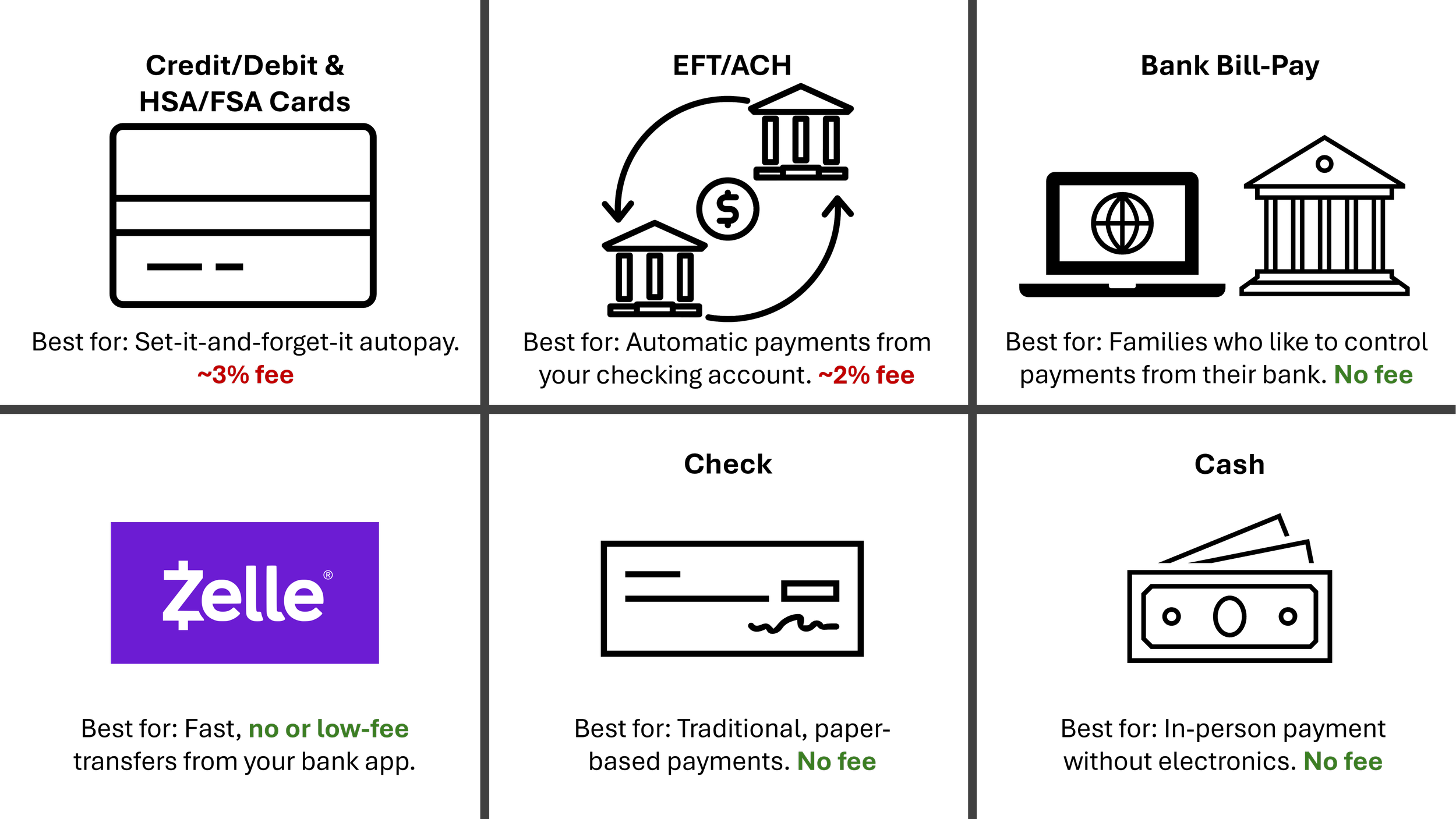
-
What it is:
You provide a credit, debit, or eligible HSA/FSA card. With your permission, the card can be securely stored and charged before sessions or on a pre-arranged schedule.Why families like it:
Very convenient and easy to put on autopay.
Can be kept on file so you don’t have to remember payments each week.
HSA/FSA cards may allow you to use pre-tax funds for eligible services.
Receipts are easy to download for your records or for insurance reimbursement.
Things to consider:
Card must be current and have available funds.
If a card is declined, payment must be resolved before services can continue.
Card payments include a processing fee (currently 2.9% + $0.60 per successful payment, which is about 3% of most charges).
Processing fees are set by Stripe/CarePatron and may change over time.
-
What it is:
You share your bank routing and account number through a secure form. Play to Say Therapy can then automatically withdraw payments (similar to a direct debit) for scheduled services or prepaid bundles.Why families like it:
Draws payments directly from your checking account with the option for automatic scheduling.
Ideal for families who prefer not to use a credit card.
Works well for regular weekly therapy or prepaid bundles.
Things to consider:
Payments can take a few business days to fully clear.
If a payment is returned (NSF), your bank may charge a fee and services may pause until resolved.
Requires you to notify us if your bank account information changes.
ACH payments still include a processing fee (currently 1.9% + $0.60 per successful payment) and can take a few days to fully clear.
Processing fees are set by Stripe/CarePatron and may change over time.
-
What it is:
You log into your own bank’s online bill-pay system and schedule a payment to Play to Say Therapy. Your bank may send an electronic transfer or mail a check on your behalf.Why families like it:
You control the timing and amount directly from your bank.
Often no added fee from Play to Say Therapy when using this method.
You don’t have to keep a card or bank information on file if you prefer not to.
Many banks let you set up recurring monthly payments.
Things to consider:
You must schedule payments early enough so they arrive before services are provided.
Please include your child’s name in the memo so we can match the payment correctly.
Mailed checks from bank bill-pay still require mailing and processing time.
-
What it is:
You send payment through your bank’s app or Zelle app directly to Play to Say Therapy’s business account (details provided at intake).Why families like it:
Very fast and convenient—often shows up within minutes.
Easy to send from a phone, tablet, or computer.
Play to Say Therapy does not add extra processing fees for Zelle payments.
Things to consider:
Transfers can be hard to reverse and may be limited by your bank’s daily or monthly caps.
You must enter the recipient information carefully; misdirected payments are difficult to recover.
Payments still need to be sent in time to be received before services.
-
What it is:
You write a check payable to Play to Say Therapy and provide it ahead of services, either for individual sessions or for a prepaid bundle.Why families like it:
No additional processing fee from Play to Say Therapy.
Familiar option for many families.
Can be used to prepay for several sessions at once.
Things to consider:
Checks must arrive and clear before services are provided.
Returned checks (e.g., insufficient funds) may result in a returned check fee.
You need to mail or deliver checks with enough time for processing.
-
What it is:
You pay in cash at the clinic and receive a written receipt. Cash can be used for a single visit or to prepay several sessions.Why families like it:
Simple, immediate payment with no extra processing fee from Play to Say Therapy.
Helpful if you prefer not to use electronic methods.
Things to consider:
Cash must be handed in person and should not be mailed.
Exact change is appreciated; large bills may not always be able to be broken.
If cash is lost or not properly documented, it is difficult to trace or replace.